
Working Groups
The Irradiation Panel’s working groups bring together teams of experts who collaborate on technical and strategic topics that advance the safe, effective, and innovative use of irradiation technologies.
Only Panel members can participate in our working groups. If you are a Panel member and would like to get involved, please contact us at [email protected].
If you are not yet a member, find out more about becoming a member.

Working Groups
Irradiation Working Group

The group is developing comprehensive guidance for the radiation sterilization community to advance dosimetry, process control, parametric release and Monte Carlo simulation practices. This addresses current guidance gaps in standardized validation methods, and/or quality assurance practices. The working group also considers improving practices in implementing Monte Carlo simulation and modelling as development tools and application of parametric release practices in radiation processing.
Working Group Lead
Florent Kuntz
Strategic Development Manager, Aerial

Active Sub-groups
Release Based on Irradiation Parameters (RBIP) Task Group
The RBIP Task Group is working on publishing guidance on releasing sterilized products from electron beam irradiation processes based on irradiator parameters. This provides an alternative release methodology for e-beam sterilization.
Sub-group Leads:
Mark Bailey
Risø HDRL – DTU Health Technology
Florent Kuntz
Aerial
Monte Carlo (MC) Simulation Task Group
The MC Simulation Task Group is developing a comprehensive roadmap to establish simulation as a trusted tool in radiation sterilization, including standardized validation methods, uncertainty estimation frameworks, standardized phantoms, training programs, and operational qualification guidelines for simulation tools.
Sub-group Leads:
Damien Prieels
IBA
Abbas Nasreddine
Aerial
Release from an Electron Beam Irradiation Process Based on Irradiator Parameters (RBIP): Introductory Guidance
View Publication View Publication
ISO 11137-1 “Sterilization of health care products – Radiation – Part 1: Requirements for the development, validation and routine control of a sterilization process for medical devices” : Note on differences between 2025 and 2006 versions
View Publication
Microbiology Working Group

The Microbiology Working Group is dedicated to strengthening sterility assurance for radiation‑sterilized products. We collaborate to share ideas, best practices, and lessons learned related to the microbiological elements of sterility assurance. Our activities include developing guidance papers to address identified gaps, providing feedback on new or revised international standards, as well as forming focused sub‑groups to advance key initiatives such as the current projects outlined below.
The Microbiology Working Group is focusing on key initiatives in microbiological control, work includes investigating sterilization dose audit (SDA) positives to better understand the microorganisms that survive irradiation; reviewing and verifying D10 values to ensure accurate, up‑to‑date data; developing practical microbiological guidance to help manufacturers meet the requirements of ISO 11137, ISO 11737, and ISO 13004 whilst also contributing expert feedback to international standards development.
Working Group Lead
Nicola Bench
Associate Director, Global Sterility Assurance, BD

Active Sub-groups
Sterilization Dose Audit Positives
Sharing knowledge of the types and sources of surviving microorganisms. Tasks include developing an SDA positive database, collecting and analysing SDA positives and their root causes, gathering case studies and creating a guidance paper on best practices for investigations into those surviving microorganisms.
Sub-group Leads:
Stephanie Gray
BD
D10 Study
Ensuring relevant, up to date, standardized D10 information. Tasks include facilitating a thorough review of published data, determining the most appropriate method and utilizing this method to verify the D10 values of selected SDA positives identified in sub-group
Sub-group Leads:
TBD
Microbiological Aspects of ISO 11137, 11737 and ISO 13004
Providing guidance and considerations for meeting the requirements and achieving a SAL including an overview of the principal standards governing radiation sterilization, best practices founded on industry expertise and information and guidance to meet requirements.
Sub-group Leads:
Khevna Patel
Cytiva
Guidance on the establishment of timeframes for testing associated with the requirements of ISO 11137, ISO 11737 and ISO 13004.
View Publication
EN/ISO 11737-2 “Sterilization of health care products – Microbiological methods – Part 2: Tests of Sterility performed in the definition, validation and maintenance of a sterilisation process’’ Note on differences between 2009 and 2019 versions
View Publication
Guidance on the Sterility Dose Audit Failure Risk Assessment as per the requirements of ISO11137 standard
View Publication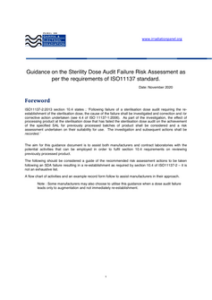
EN/ISO 11737-1 “Sterilization of health care products – Microbiological methods – Part 1: Determination of a population of microorganisms on products” Note on differences between 2006 and 2018 versions
View Publication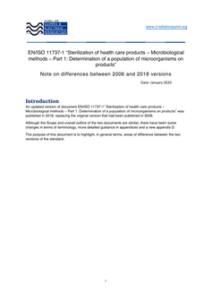
Building a database of Sterilization Dose Audit positives to analyse trends seen across the industry
View Publication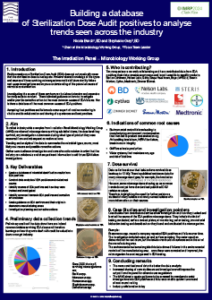
Education & Training Working Group

Formalised in April 2023, this working group is focused on creating educational material aimed at individuals at the beginning of their career in the radiation sterilisation industry.
Comprised of members who bring experience from across radiation processing, manufacturing, packaging, laboratory services and auditing, the team is dedicated to making content accessible for those entering the industry, helping them understand the fundamental principles that underpin the industry and support career progression.
The current focus of the group is to identify, assess, categorise and create entry level content across various topics relevant to industry. Utilising the frameworks created by SfSAP, the group is creating a series of modules that can be accessed as a complete series or as targeted learning resources for specific topics.
Alongside this top-level assessment, the group creates and reviews content to ensure it is industry relevant, accurate and engaging, with a structured revision and control process envisaged to maintain alignment with current standards.
While the focus is on supporting self-motivated learning, the group recognises the value of in-person training, and aims to collaborate with providers to promote awareness of complementary learning resources and opportunities.
As the Educational and Training Working Group’s primary objective is the development of educational resources and learning materials, it does not produce traditional publications. Instead, its focus is on creating practical training content that supports knowledge development and professional growth within the irradiation industry. The modules will feature training content related to sterility assurance, radiation technologies and associated performance qualifications, as well as microbiological quality and related testing activities.
Working Group Lead
Emily Rodgers
Joint Managing Director, MVS Ltd

Working Group Deputy Chair
Vicki Pearson
UK Laboratory Validations &
Technical Manager, STERIS AST

Active Sub-groups
Content Creation
Leading the development of educational modules and creating guidance to support the production of learning materials. This group also explores the use of AI and other tools to understand how they can be utilised to support content development while maintaining quality and accuracy.
Sub-group Leads:
Christopher Mitchell
Medtronic
Daniel Longhorn
Abbott Medical
Hosting and Technical
Supports content creation by reviewing different applications to identify the best tools for developing and delivering educational content. The subgroup also helps ensure all content follows a consistent format and is presented uniformly.
Sub-group Leads:
Martin Lowe
Swann Morton